
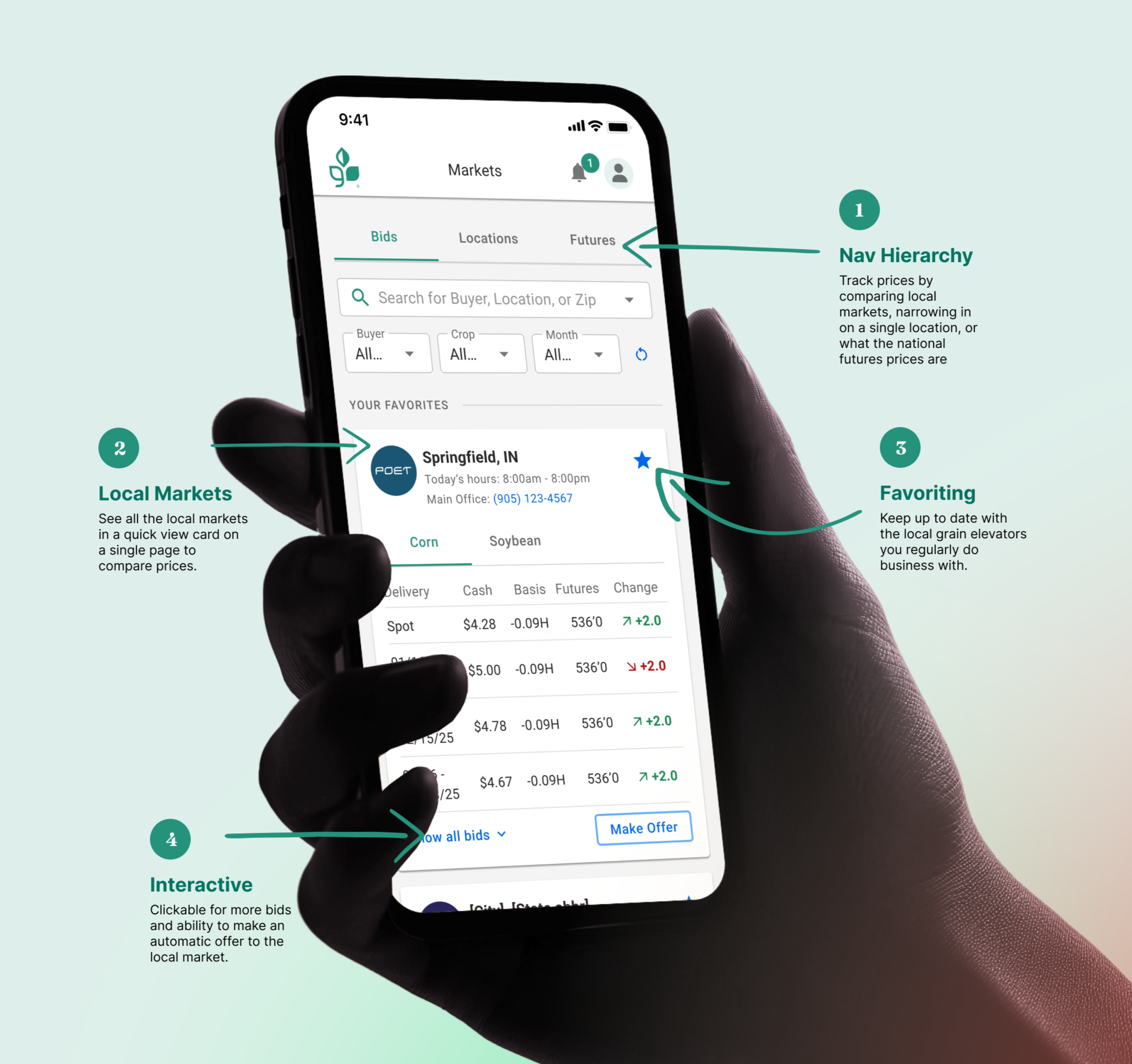
A Single Grain Market suite helping answer:
"Should I sell my grain today?"
At Gradable, I designed and delivered a comprehensive grain markets ecosystem that empowered farmers to answer the critical question: "Should I sell my grain today?" By unifying localized bids from major partners with national CME futures, I transformed fragmented market data into a streamlined, four-tiered decision engine.
The suite provided farmers with real-time "basis" indicators and global trend visualizations, allowing them to navigate market volatility and execute high-value sales directly from their mobile or desktop devices.
Overview
In the volatile world of agricultural commodities, timing is everything. Farmers need to digest complex market data instantly to decide when to sell. This project involved a complete overhaul of the Grain Markets experience on the Gradable app, moving from a cumbersome, disjointed data set to a tiered, actionable ecosystem.
By integrating real-time bids from partners like ADM and POET with national CME futures data, we created a seamless flow from high-level glanceable dashboard metrics to deep-dive individual location analysis.
Role:
Lead UX Strategist & Designer (Sole Designer on Project)
Organization:
Gradable (part of Farmers Business Network - FBN) partnered with ADM (Archer Daniels Midland) and POET Ethanol
Deliverables:
End-to-End UX Strategy, UI Design (Mobile & Desktop), Multi-tiered Navigation Structure, Design System Integration, and Engineering Handoff.
Tools:
Figma, Miro, Online User Testing Platforms
Duration:
Iterative release over 3 months
Background & Problem
The legacy experience on Farmers Business Network, our parent company, was fragmented. Farmers had to navigate multiple screens and special screens only for our partners to find localized bids and then compare them manually against national futures.
The Pain Points:
Information Overload: The bids experience was noisy, making it difficult to make quick, confident selling decisions.
Disjointed Data: Localized partner bids and national futures lived in separate silos, forcing the user to do the mental math of basis (the difference between local and national prices).
Navigation Fatigue: Users had to hunt for specific favorite locations through multi-step menus or hidden filters.
Partner Visibility: Partner grain buyers were concerned that their locations were being overshadowed by non-partner data.
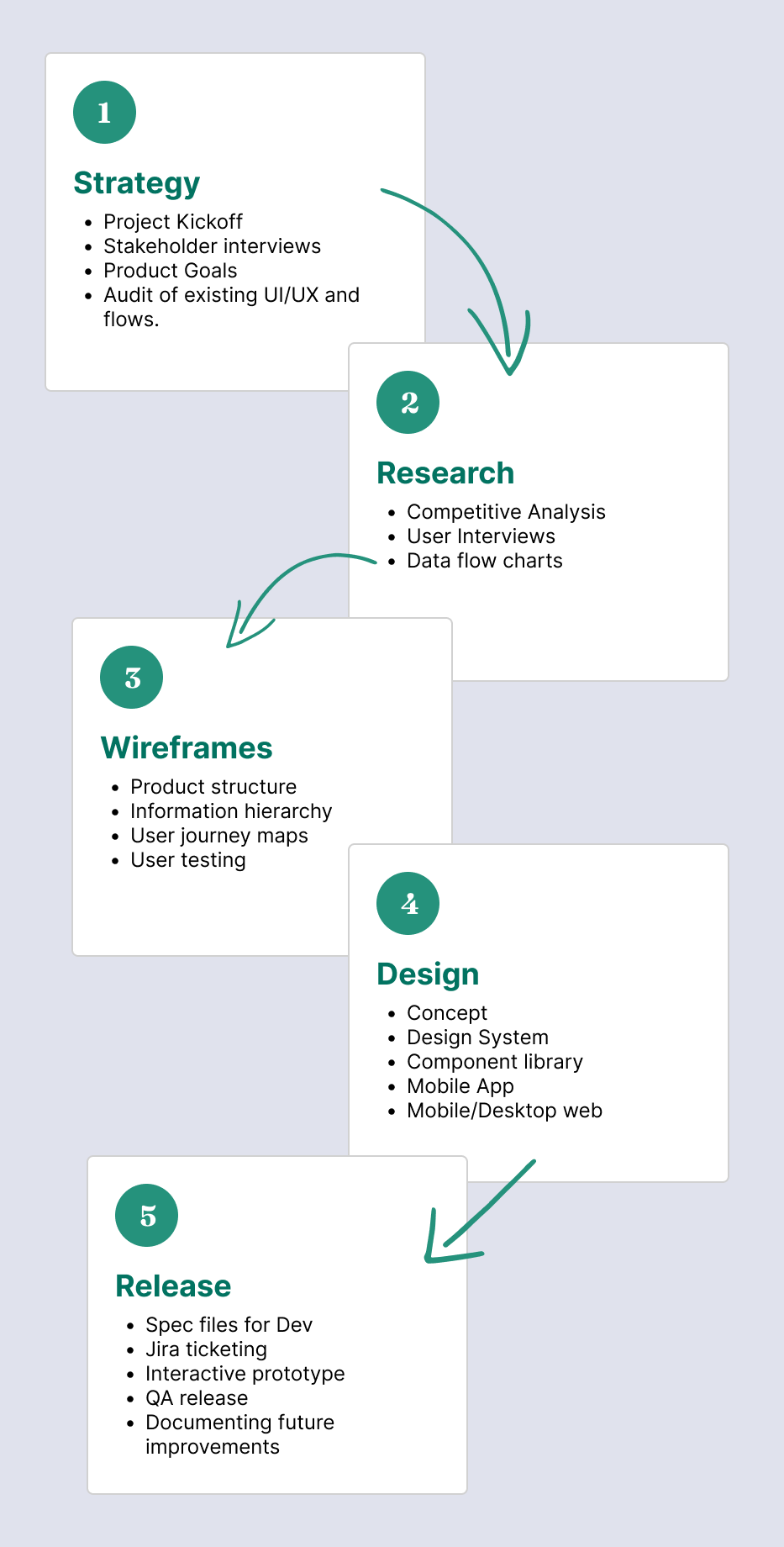

Research, Interviews, and Testing
To solve for speed to decision, I focused on the farmer's mental model:
Local Price vs. National Trend.
On-Site Context: Building on my research at major grain elevators, I focused on the high-stress environment where these tools are used. A farmer needs to see a price change while in a truck or on a tractor without digging through menus.
User Journey Mapping: I mapped the decision-making process from the morning check on the dashboard to the final "Make Offer" action.
Stakeholder Alignment: Worked with product leadership to define how Favorite locations are automatically determined for integrated partners, displaying the top 1 to 3 active sites.
Competitive Audit: Analyzed the existing FBN charts and external tickers to identify how to beautify and simplify complex financial trend lines into glanceable sparklines.
Design Strategy:
The 4-Tiered Market Ecosystem
Our strategy shifted the product from a data list to a comprehensive financial decision engine. We organized the experience into four distinct pillars that mirror the farmer's narrowing focus from global trends to local action.
Quick Glance
The Dashboard:
Provides a high-level summary of "favorite" local bids and a live national futures ticker.
The Comparison
All Bids Page:
A segmented view allowing farmers to compare multiple partner locations and nearby bids in one view.
The Deep-Dive
Single Market Page :
A location-specific view for checking hours, delivery info, and specific crop bids.
The Benchmark
National CME Page:
A re-beautified view of the Chicago Mercantile Exchange futures to provide global market context.
Home Dashboard: Quick Glance
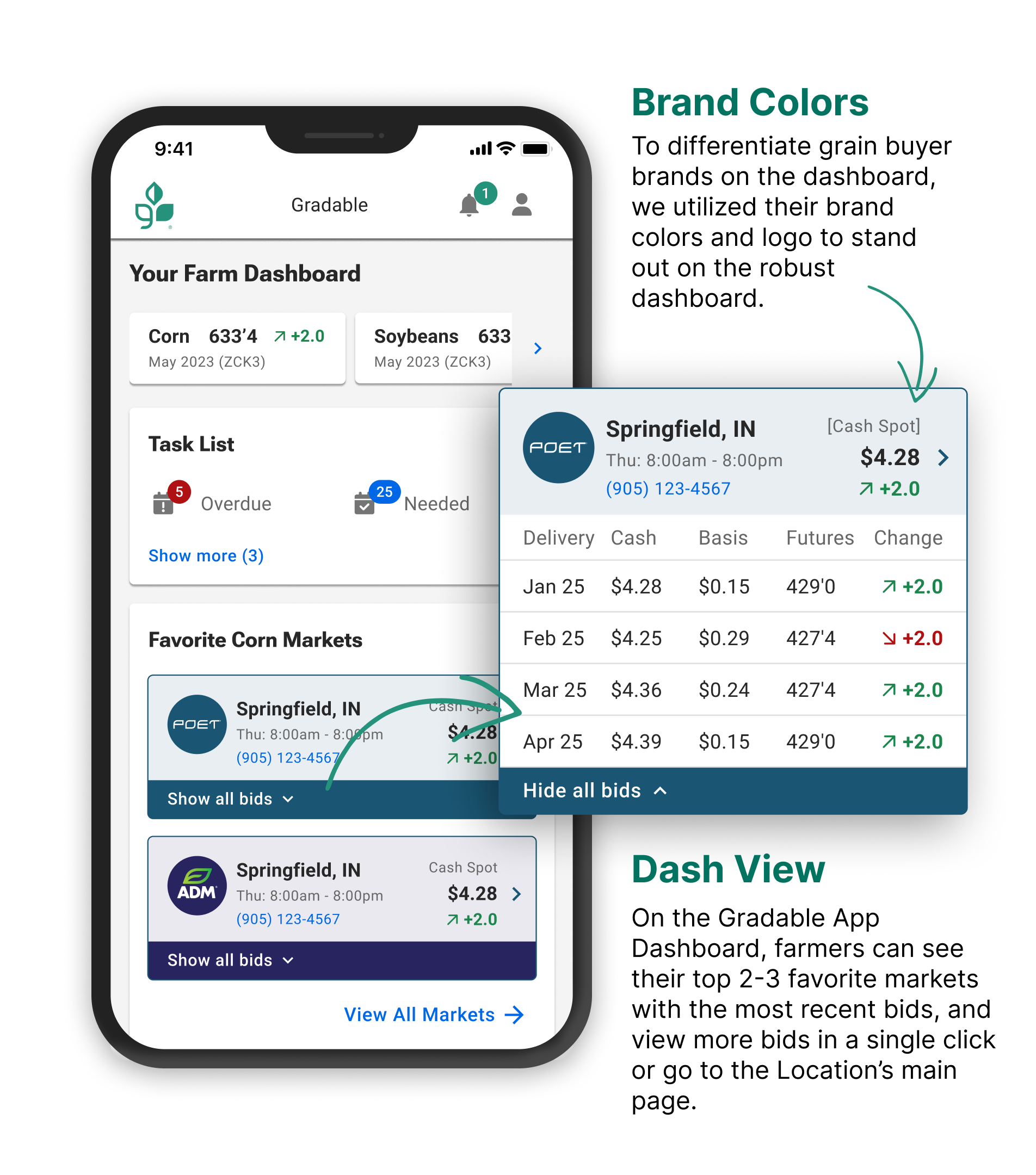
The dashboard serves as the initial "pulse" of the market. My goal was to answer the question, "Is anything moving today?" without requiring the user to leave the home screen of Gradable, but giving them the ability to deep dive one click away.
The Bids Card: I designed this to surface the latest prices for the farmer’s top two favorite or integrated locations. By placing it directly above the Contracts card, we prioritize the most immediate financial decision.
The Basis Indicator: To provide instant context, I implemented color chips that highlight the "basis," which is the difference between local cash prices and national futures. Success Green indicates a price higher than futures, while Error Red indicates it is lower. This allows a farmer to gauge local market strength in under five seconds.
Strategic Branding and Differentiation: Our grain partners needed to stand out in a space where farmers often sell to multiple, competing distributors. To solve this, I utilized specific brand colors and logos within our card templates. During partner onboarding, we collect these brand assets to be implemented throughout the app.
User-Validated Visual Style: Through testing, I moved toward a more colorful style using background brand colors. Users reported that this "colorful" approach made it significantly easier to distinguish between different buyers at a glance. The color "popped" more, providing a clear visual cue that allowed farmers to identify their preferred companies instantly.
All Bids: High-Efficiency Comparison of Local Markets
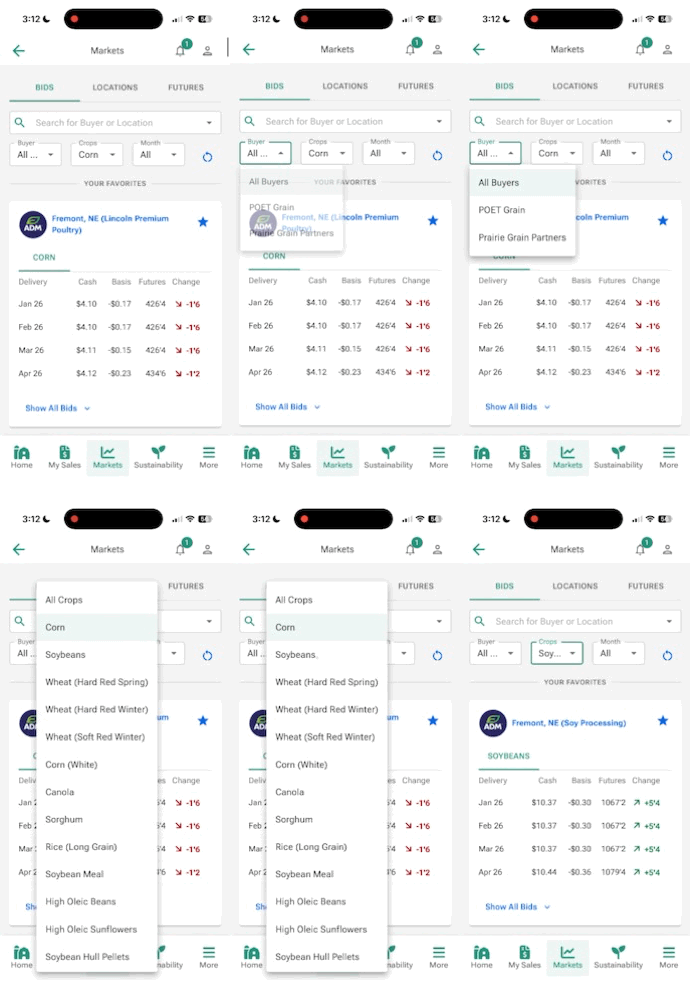
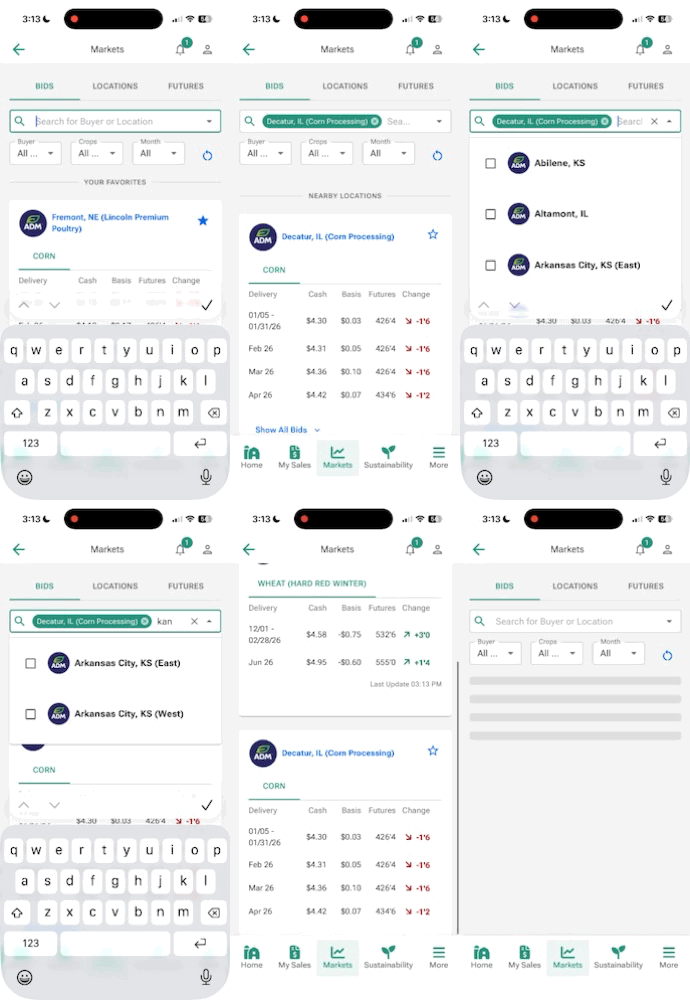
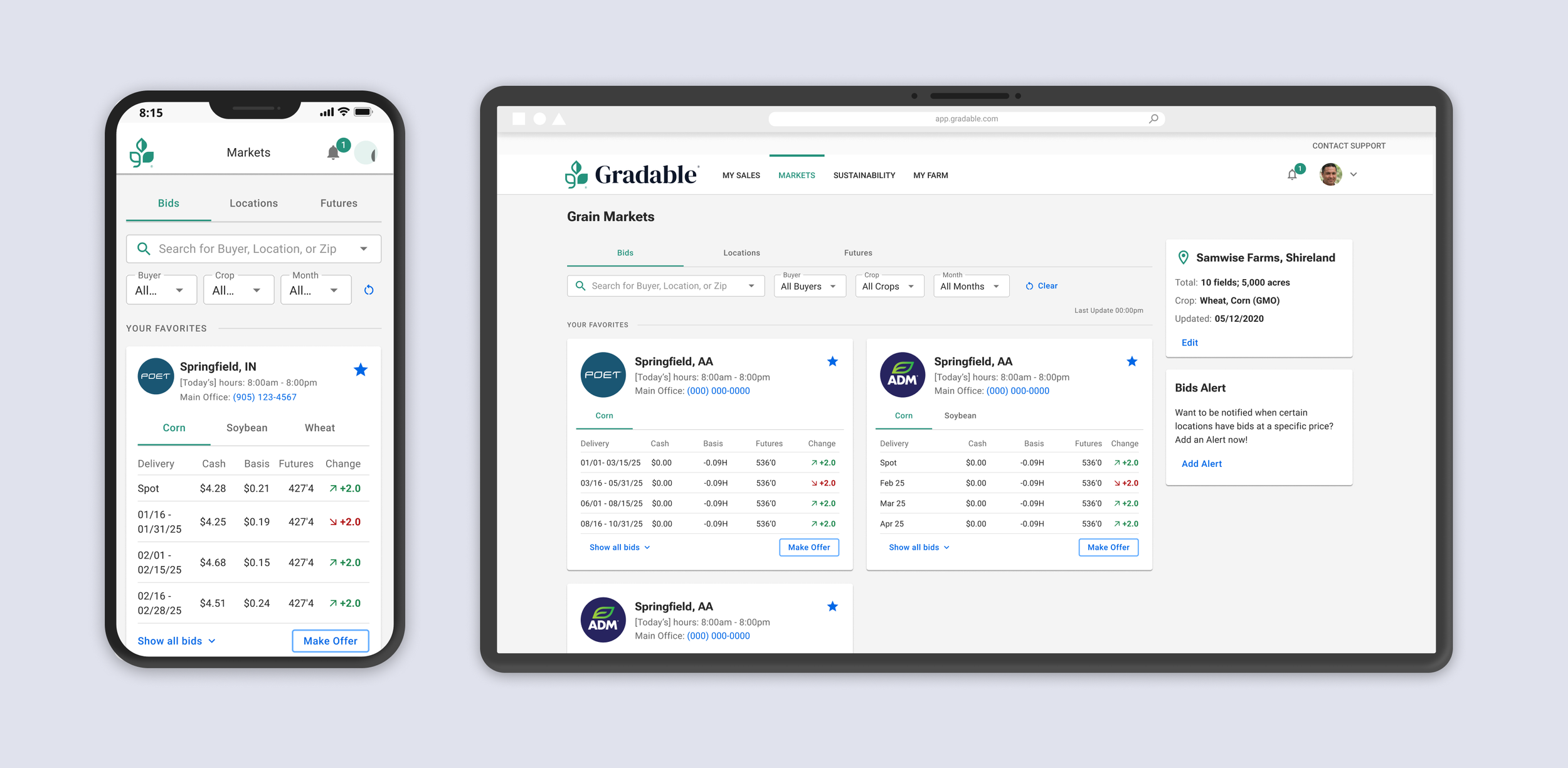
Once a user decides to investigate further, they move to the Bids view to see all local markets within a couple hundred miles. This tier addresses the "operational drag" of searching through hundreds of potential buyers by organizing them into a clear hierarchy.
Segmented Hierarchy: I formalized a layout that pins favorite locations to the top, followed by all integrated partner sites. This ensures that the most relevant data is never buried.
Masonry Location Cards: Because different grain elevators handle a varying number of crops, I utilized a MUI Masonry layout. This ensures a cohesive stack of location cards that adapt to data volume without leaving awkward white space.
Smart Filtering: I integrated filters for Crop, Month, and Partner, allowing farmers to narrow down complex data sets into a manageable subset tailored to their specific harvest.
Predictive Search: I implemented a type-ahead search feature that allows farmers to instantly find and select specific grain locations. This functionality enables users to curate their experience by selecting one or multiple locations, reducing cognitive load and transforming a generic list into a personalized, high-precision dashboard.
Single Market: The Deep Dive
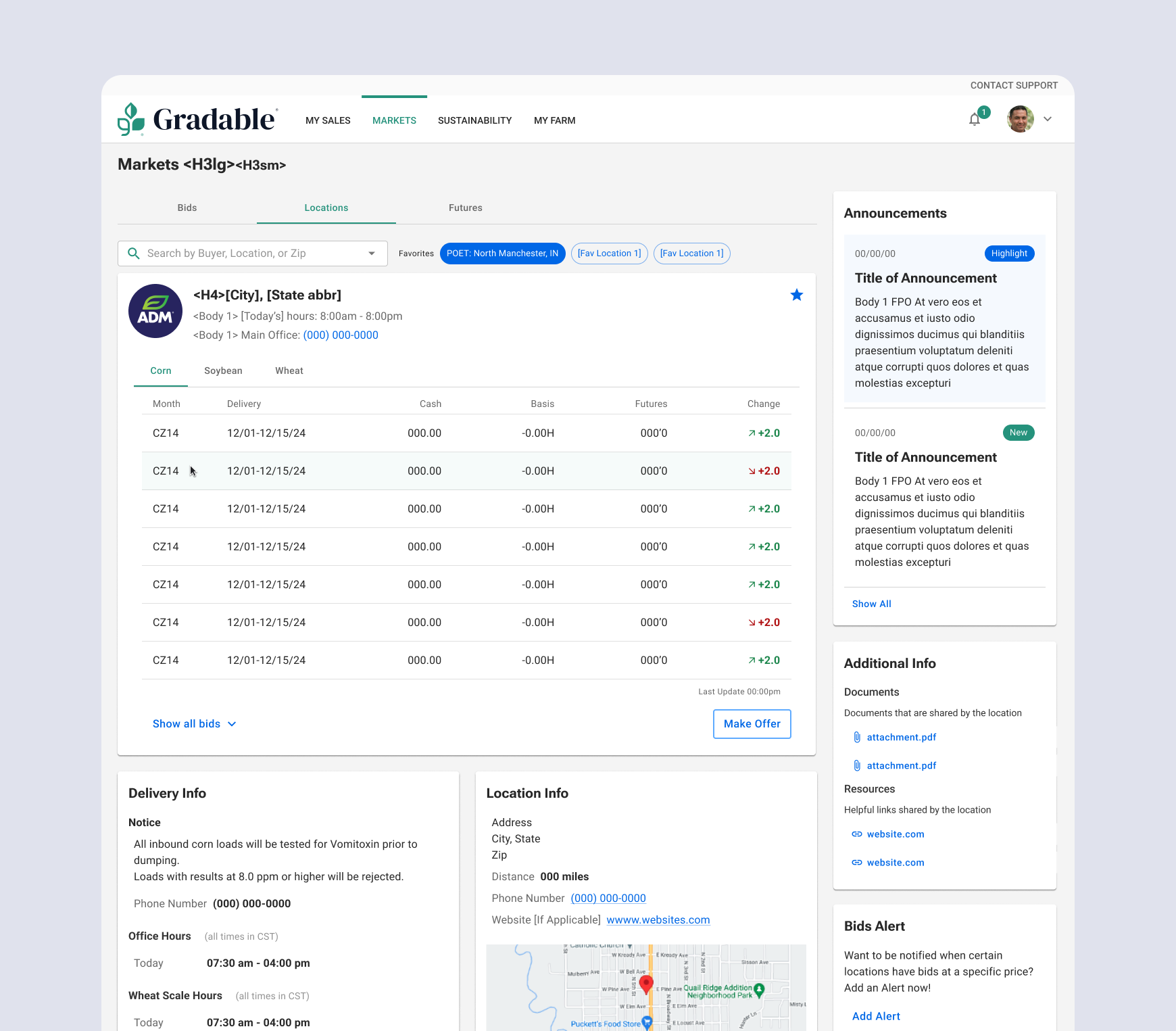
The Single Market page serves as the final tactical stop in the user journey, moving the farmer from analysis to execution. My goal was to eliminate the disjointed experience between public partner pages and the logged-in app by creating a unified, tiered data experience.
Bridging the Fragmented Experience: Previously, location details and bids were split between public sites and a separate logged-in versions per company. I combined these into a single, cohesive interface that provides a deep dive into specific location data while maintaining the Gradable brand identity.
Operational Header and Brand Presence: I designed a high-density header that includes the location name, real-time operating hours, and contact information. To maintain partner trust, I ensured prominent brand presence while integrating a "Favorite" action that allows users to instantly pin the location to their high-level dashboard.
Dynamic Bids Table with Crop Tabbed Navigation: To handle the complexity of multiple commodities, I implemented a tabbed navigation system for different crops. The table features a "last updated" timestamp and a status chip for price changes (+/-), providing the farmer with immediate confirmation of market volatility before they commit to a sale.
Contextual Operational Data: Beyond the numbers, I integrated essential "physical" data points such as site-specific announcements, delivery information, and logistics. This ensures the farmer has the full context of the elevator's current status, like wait times or equipment issues, before they put a truck on the road.
Direct Transactional Handoff: The "Make Offer" button is the primary call to action, integrated directly into the location header. This triggers a pre-filled dialog that streamlines the negotiation process, effectively turning a passive data-viewing experience into an active business transaction.
National CME Markets: The Global Benchmark
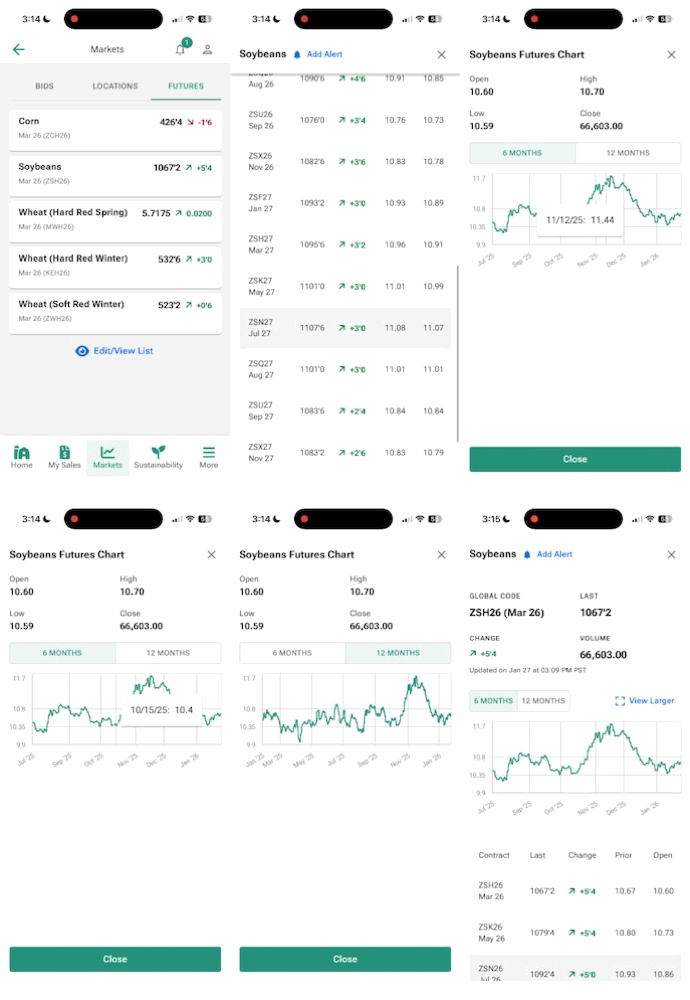
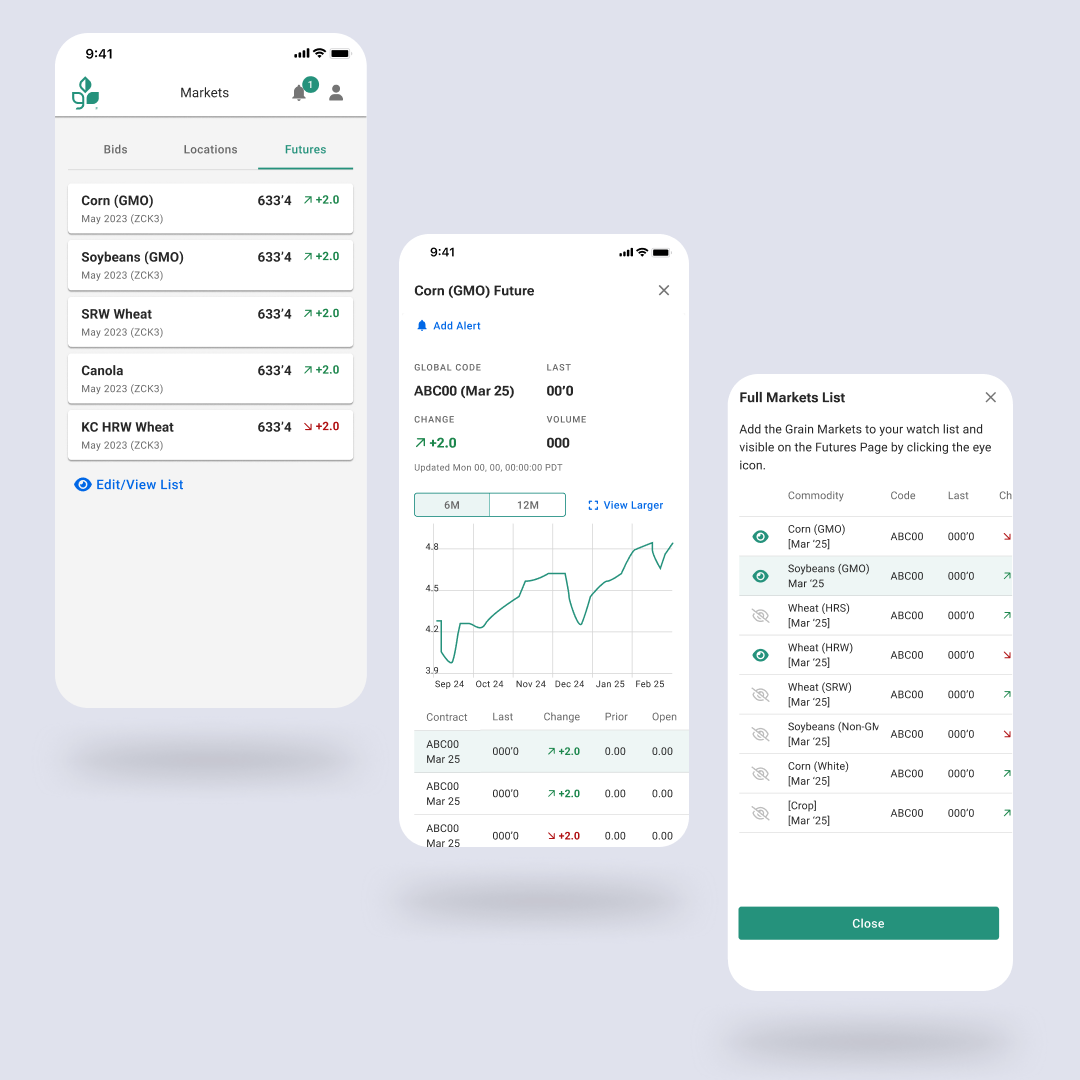
The final tier provides the long term market context required for a successful crop marketing strategy. I wanted to move away from static tables and toward visual education.
Trend Visualization: I replaced dense rows of text with 6 and 12-month Sparklines. These trend lines allow farmers to visualize the direction of the Chicago Mercantile Exchange (Corn, Soybeans, Wheat) rather than just seeing a single point in time.
Integrated Alert System: To ensure the fastest path to action, I designed an alert dialog that pre-fills based on the user's current context. If a user is viewing the Soybean futures, the Add Alert dialog opens with Soybeans already selected, allowing them to set SMS or Push notifications for specific price targets with minimal effort.
Outcome
The new Markets Suite transformed Gradable from a data repository into a decision-engine.
Streamlined Decision Making: Farmers can now answer "Should I sell?" from the dashboard in seconds, rather than minutes.
Integrated Alerts: By reskinning the alert system into the Gradable brand and making it accessible from both local and national views, we increased user engagement with price targets.
Unified UI: Combined the public-facing partner pages with the logged-in farmer experience, creating a singular, cohesive brand voice.
Scalability: The modular MUI-based design allows for future iterations, such as adding non-integrated locations or custom storage cost calculators, without breaking the core layout.