Orchestrating the Sustainability Data Engine
A Systems-First Approach to Regenerative Agriculture Incentives
At Gradable, I designed and delivered the core sustainability data platform that enabled grain farmers to enroll in regenerative agriculture programs and earn rebates based on their existing practices. As the sole designer, I architected a modular system of conversational questionnaires that captured complex practice data, then built the relational engine that allowed farmers to assign those plans to specific fields and track their enrolled acreage against contractual commitments.
The platform contributed to a more than 265% increase in rebates paid, growing from $5.2M to over $19M in a single crop year, enrolled over 4,100 new farmers in 2024, and achieved 61% weekly retention in an industry where software stickiness is notoriously hard to earn.
Background
Farming runs on thin margins. A grower managing thousands of acres might operate on $30 to $50 profit per acre in a good year, so a missed rebate genuinely reshapes a season.
Most sustainability programs only pay for new practice changes. Farmers who had spent years building regenerative practices into their operations were getting nothing for it. Our platform was built to change that: recognize and reward what farmers were already doing, using a Carbon Intensity (CI) score calculated by our data science team from peer-reviewed research. Lower CI score, higher rebate.
The problem was getting farmers enrolled. The data entry burden was so high they were walking away from money.
Title:
Senior/Lead Product Designer (Sole Designer on Project)
Organization:
Gradable (part of Farmers Business Network - FBN)
Project Roles:
Research, Conceptualization, Systems Architecture, Design, Usability Testing, Dev Handoff
Tools:
Figma, Miro, Online User Testing Platforms, Internal Agronomy Tools
Duration:
Ongoing releases and iterations across three crop years
Problem
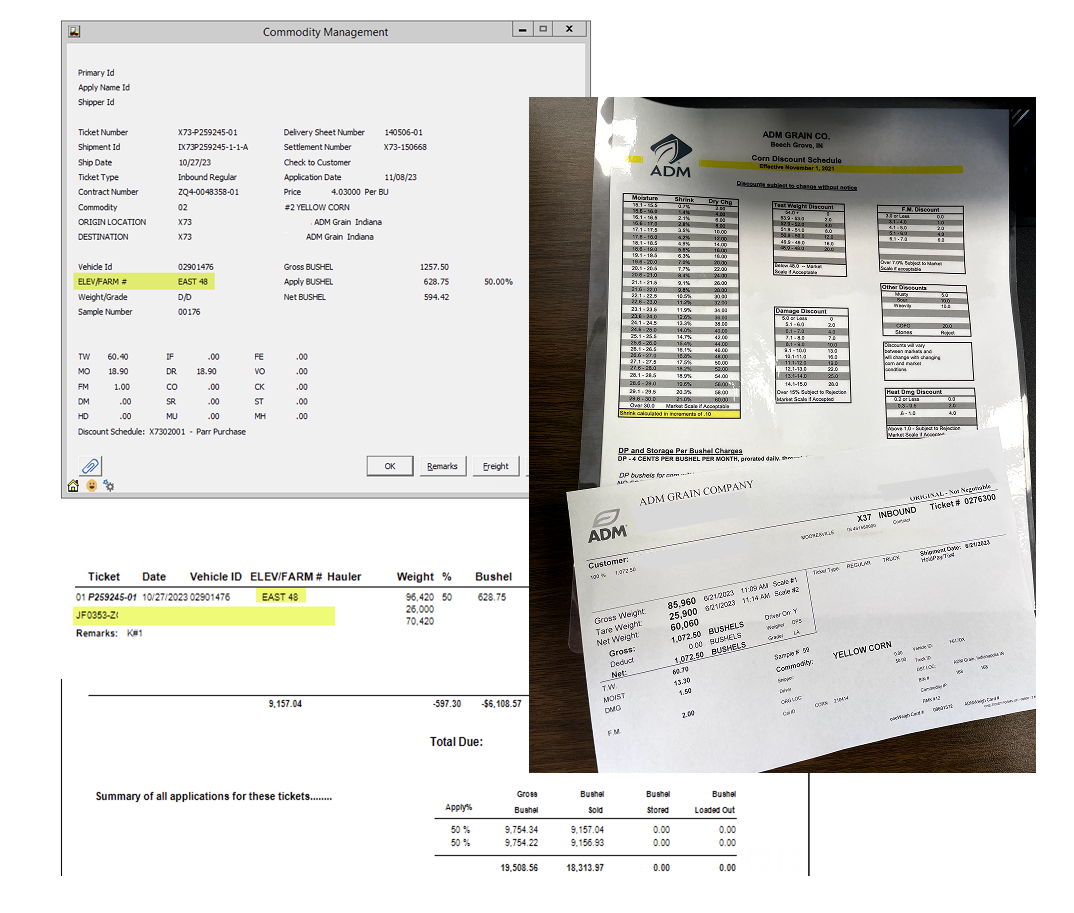
Farmers' operational data existed in three disconnected places: legal contracts, precision equipment files from John Deere or Case machines, and their own seasonal records. There was no bridge. Enrollment meant manually reconciling all three from scratch.
New regulatory requirements like the EUDR were adding more complexity on top. For a farmer managing 50+ fields, the form had become a second job.
The core pain points:
No way to import existing data, everything required manual re-entry
Form exposed all questions at once regardless of relevance
Years of good practice had no path to recognition without re-proving history
Completed practice questionnaires had to be manually assigned to individual fields, with no system to manage those many-to-many relationships across dozens of fields and multiple modules
Contracted acreage commitments and GPS-measured field boundaries never matched exactly, triggering eligibility failures over rounding differences
QA failures gave no actionable feedback, leaving farmers stuck

Research, Interviews, and Testing
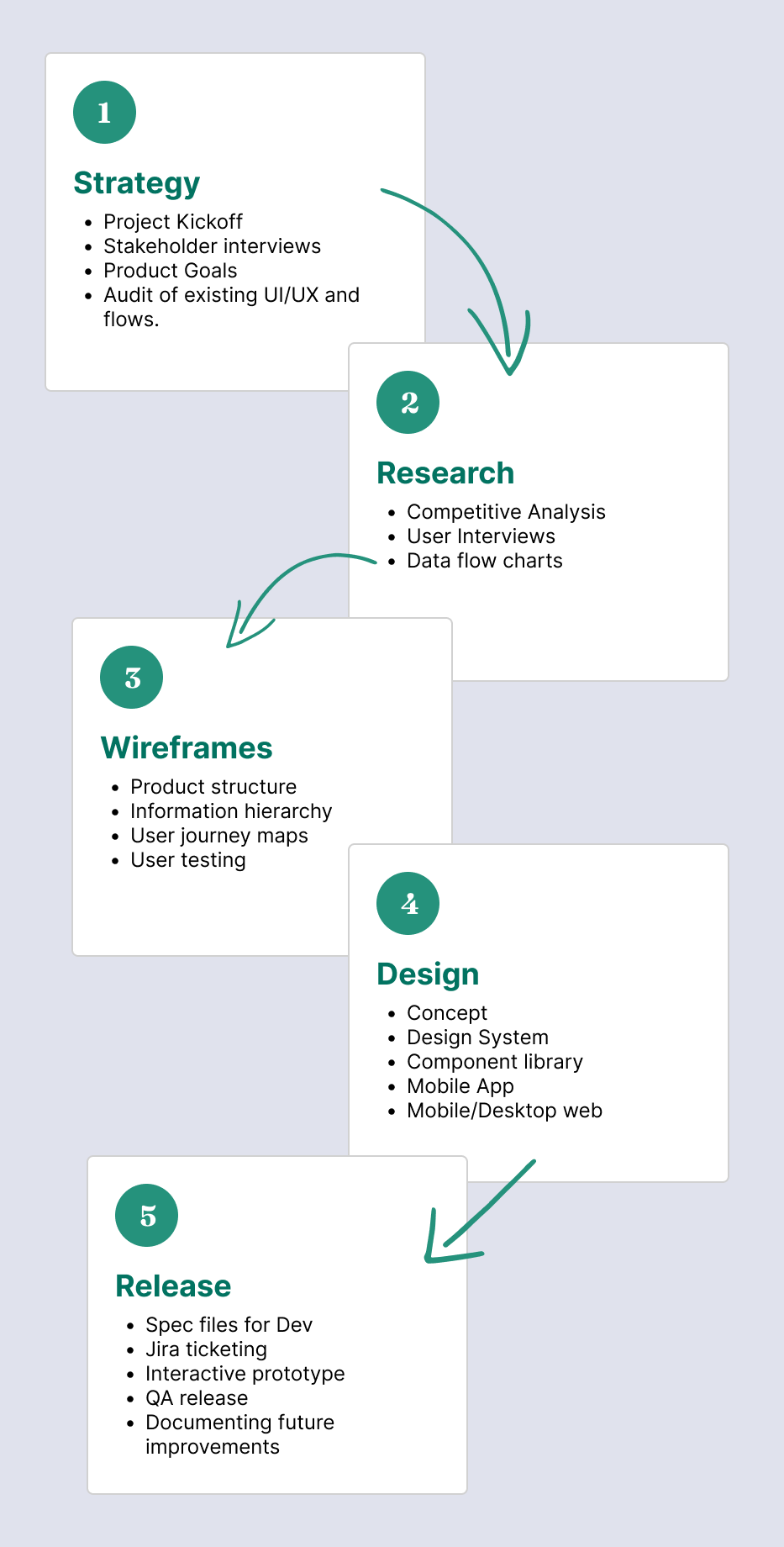
I started with the failure data. Analysis of QA errors returning from our data scientists, including 1,136 field-level discrepancies and 284 Nitrogen Use Efficiency flags, showed me exactly where the form was asking farmers to do something their equipment could not support accurately.
I interviewed Sustainability Program Leads to understand real-world friction, and worked with the Data Science team to trace which inputs were driving CI score failures. I audited all three data source types farmers used, precision files, contracts, and self-reported records, to understand their formats and limitations.
Through that process I also mapped how practice data actually needed to flow: farmers do not complete one questionnaire per farm. They complete separate module plans per practice category, then assign each plan to specific fields. Field A and B might share one Crop Protection plan while Field C has its own. Managing those relationships cleanly, at scale, across multiple modules and dozens of fields, was the real design problem underneath the form fatigue.
The insight: the biggest source of failure was not bad data. It was a system that had no architecture for the relationships between plans, fields, and acreage commitments. A better form would not fix it. The system needed a relational engine.
Design Strategy: Meet Farmers Where Their Data Lives
I designed the platform as a modular engine: each practice category lives in its own conversational module, completed plans get assigned to specific fields, and the system tracks whether the total enrolled acreage holds together. Three input modes fed the modules with as little manual entry as possible.
Conversational Logic
[ IMAGE: Progressive disclosure questionnaire, collapsed vs. expanded states ]
A "TurboTax for agronomy" stepped questionnaire using progressive disclosure. Yes/No triggers reveal only relevant follow-up questions. A grower without irrigation never sees the phosphorus questions.
Year-Over-Year Autofill
[ IMAGE: Pre-populated CY24 practice data cloned from prior year ]
An autofill engine clones the previous year's practice data and carries it forward. Long-term sustainable farmers start each enrollment cycle at roughly 80% complete. The system recognizes their history instead of erasing it.
Field and Data Integrations
[ IMAGE: Import flow from John Deere Ops, FieldView, and Case IH ]
API connections with John Deere Operations Center, Climate FieldView, and Case IH pull precision files and boundaries directly in. Manual entry became the last resort, not the default.
Design
The Field Assignment System
Each module in the platform is a conversational questionnaire that captures a specific category of practice data, such as Crop Protection or Nutrient Management. Once completed, a plan is not attached to a farm broadly. It is assigned to specific fields. Field A and B might share Crop Protection Plan 1, while Field C uses Plan 2 because the inputs or practices differ. The system had to manage these many-to-many relationships cleanly across potentially dozens of fields and multiple modules.
[ IMAGE: Field roster showing multiple fields assigned to different plans within the same module ]
Key decisions in the assignment logic:
[ IMAGE: Acreage validation state showing contracted acres vs. assigned field acres with tolerance indicator ]
10% acreage tolerance. At enrollment, farmers commit to a contracted acreage. As they assign fields to plans, the system tracks whether total assigned acres match that commitment. Because GPS-measured field boundaries rarely match legal paperwork exactly, I built a 10% tolerance threshold. If assigned and contracted acres land within that range, the system validates. This single logic change rescued hundreds of fields from disqualification over rounding differences.
[ IMAGE: Double-crop field showing two plans assigned to one field, with parent-child indicator ]
Double-crop architecture. Normally, a field can only be assigned to one plan per module. For farmers running rotations like Winter Wheat followed by Soybeans on the same ground, I designed a parent-child structure that allows two plans to share a single field. Both crops are scored accurately without duplicating the field record or breaking the assignment logic for single-crop fields.
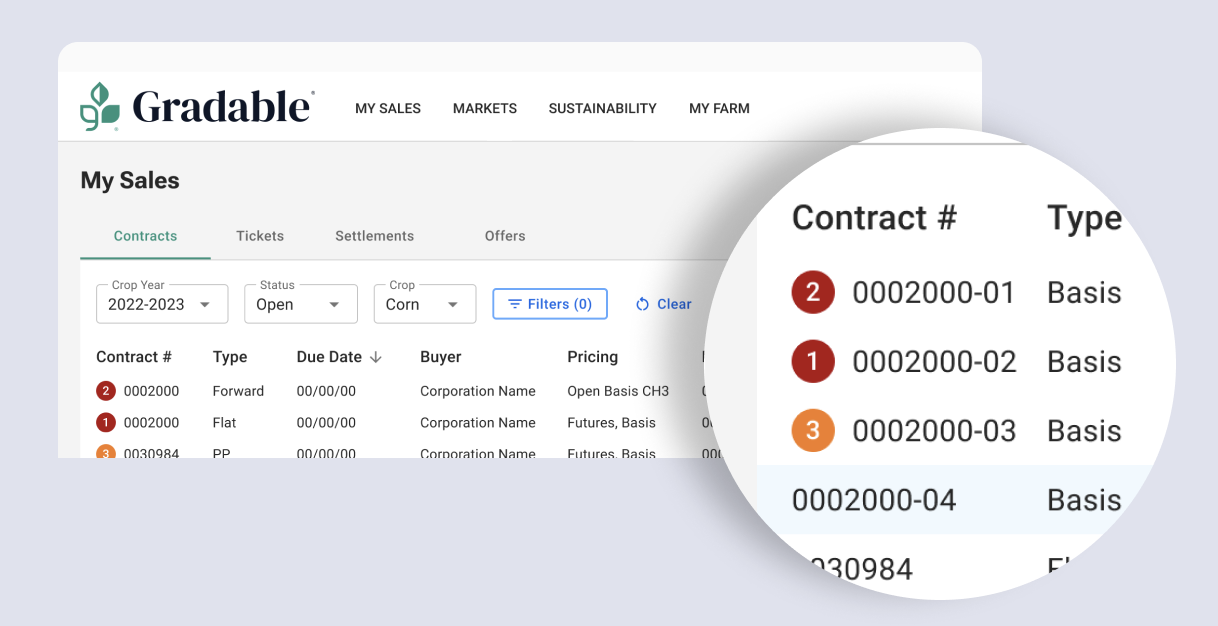
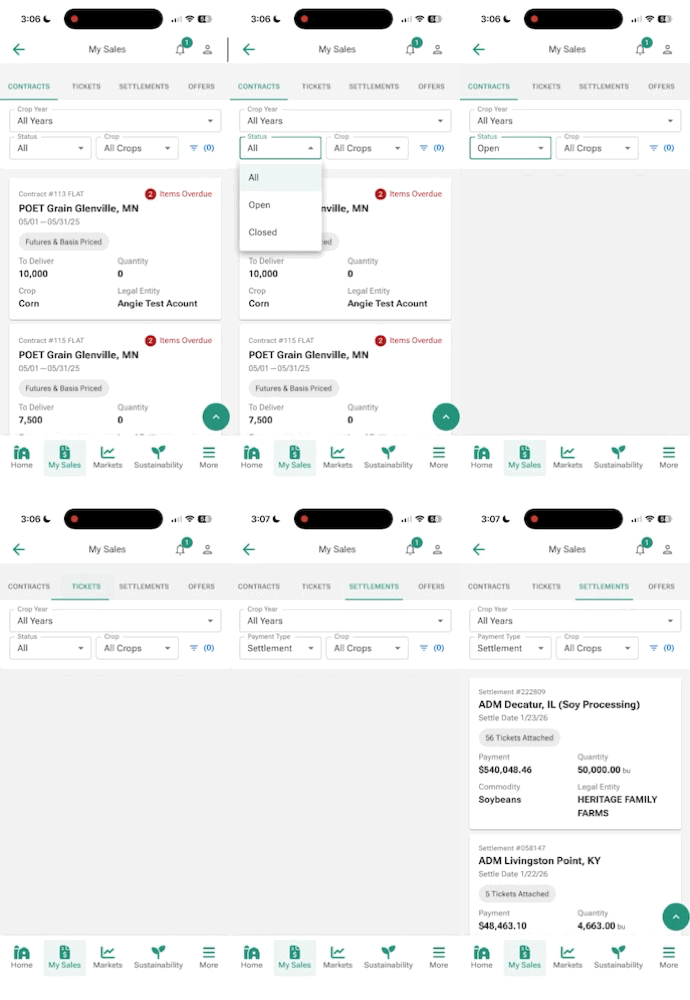
Governance and QA
[ IMAGE: "Needs Review" module state with inline field-level error message ]
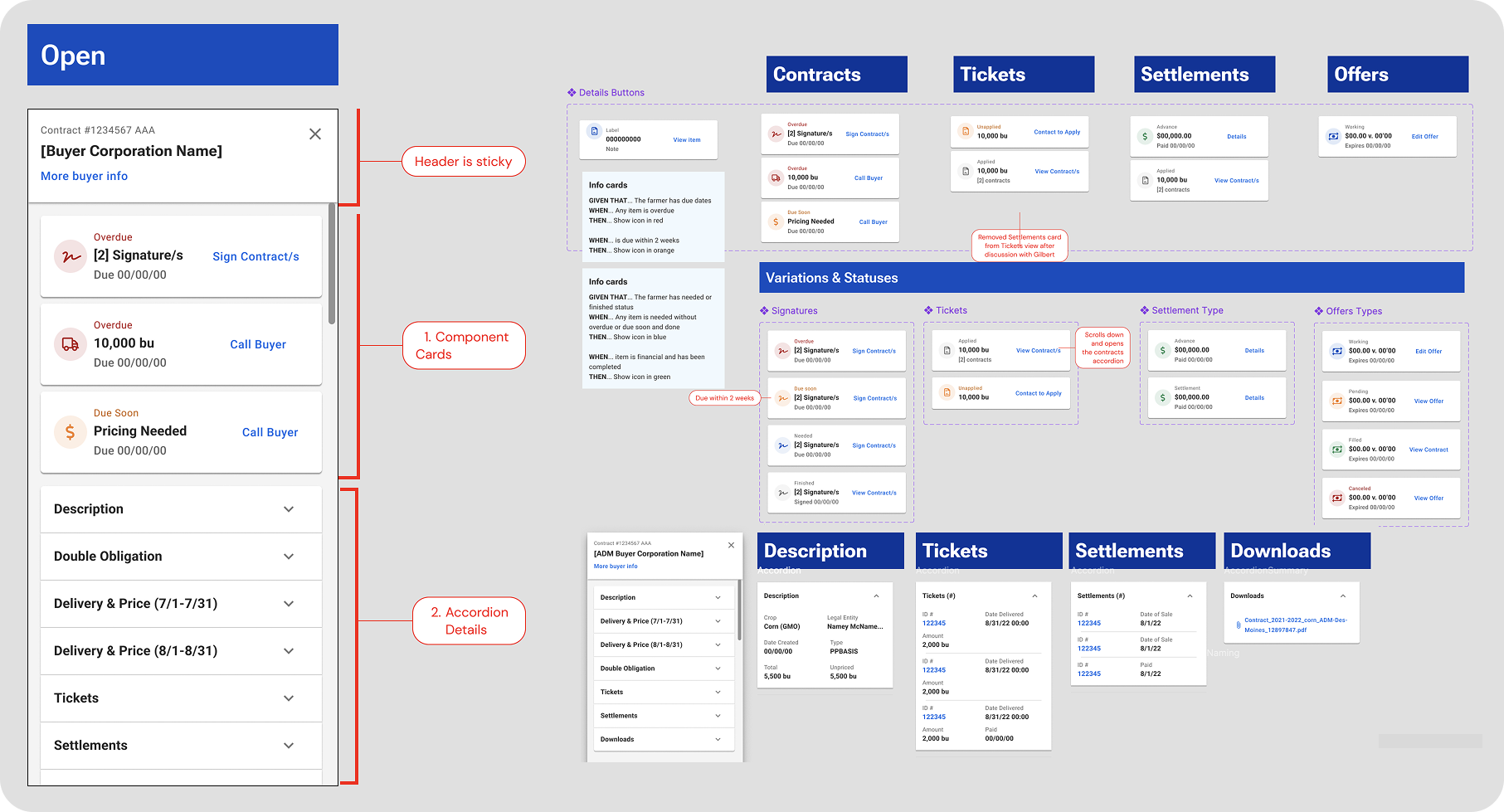
I mapped 20+ QA error codes to actionable UI states. Instead of a generic failure message, farmers see plain-language feedback at the field level. I also designed a full state machine: Not Started, Incomplete, Needs Review, Submitted, Approved. Submitted and Approved modules lock to read-only, protecting the verified record during partner audits.
From Data to E-Commerce
Completing a Crop Protection plan automatically builds a shopping list in the Gradable storefront based on planned products and enrolled acres. A mandatory compliance step becomes a procurement shortcut, with contextual nudges like "Farmers like you saved $5,000 on similar lists."
Outcomes
$19M in rebates paid in crop year 2023, up from $5.2M in 2022, a 265% increase
4,100+ new farmers enrolled in sustainability programs in 2024
61% weekly farmer retention
Gradable now operates across 12 million acres and facilitates $30M+ in annual incentives
Reflection
The 10% tolerance logic, the autofill engine, the plan-to-field assignment architecture: none of these were flashy. They were quiet decisions that kept real people enrolled and real money flowing to farmers who had earned it.
This project required moving beyond UI design into systems architecture. The interface was the last mile. The work was understanding what the data meant, where it broke down, and how to build something sturdy enough to hold together under the weight of agricultural reality.